Tell us about the job
Takes about a minute. No obligation.
A furnace repair in this county starts with a question most homeowners do not think to ask: what has the system already been through? 222 severe weather events were recorded in Sumner County, Tennessee between 2015 and 2024. At that rate, the accumulated load on electrical components, heat exchangers, and ignition systems is real, and a contractor has to work out how much of the wear in front of them traces back to that history before they can tell you what failed and what to replace. A part that looks like simple age may have been pushed there faster by repeated hard-weather cycles, and that changes the repair scope.
Parts availability shapes how a furnace repair in Sumner County goes more than the fault a contractor diagnoses. Half the homes in Sumner County, Tennessee were built in 1995 or earlier (2020-2024 ACS 5-year). A system running in a house built that long ago has likely been repaired before, and the components it takes may no longer move through standard supply chains. The contractor can open the unit and find a clear failed part, then spend the harder hours tracking down whether that part still ships.
The Parts of a Furnace a Contractor Checks First
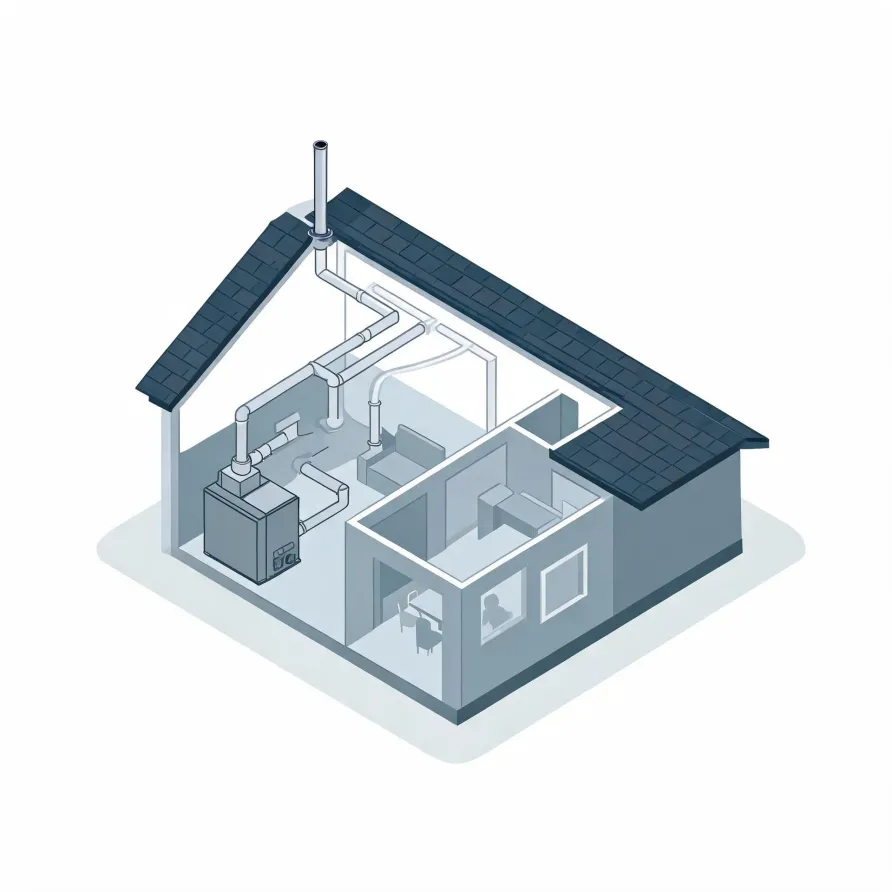
The furnace itself sits in a basement, utility closet, or crawl space and is where heat is produced. Inside it, the heat exchanger is the piece a contractor reaches for early when something is wrong: cracks or failures there let combustion gases move where they should not. The burners, which sit just below the exchanger, are another common starting point when the unit fails to heat or heats unevenly.
The blower motor sits at the base of the furnace cabinet and pushes conditioned air out through the supply side of the duct system. Alongside it, the flue or exhaust vent runs from the cabinet up and out of the house, and a blocked or corroded flue shows up quickly as a safety or performance problem. The thermostat on the wall ties the whole system together and is often the first thing a contractor tests.
The drawing beside this text shows the general layout of a furnace system, and a licensed contractor determines which parts apply to the specific equipment and configuration in your home.
Find a contractor in Sumner CountySumner County, by the numbers
222 severe weather events were recorded in Sumner County, Tennessee between 2015 and 2024.
NOAA National Centers for Environmental Information, Storm Events Database, bulk CSV export, events 2015-01-01 through 2024-12-31.Half the homes in Sumner County, Tennessee were built in 1995 or earlier (2020-2024 ACS 5-year).
U.S. Census Bureau, 2020-2024 American Community Survey 5-Year EstimatesSumner County, Tennessee holds 83,236 housing units (2020-2024 ACS 5-year).
U.S. Census Bureau, 2020-2024 American Community Survey 5-Year EstimatesOwners occupy 72.0% of the occupied homes in Sumner County, Tennessee (2020-2024 ACS 5-year).
U.S. Census Bureau, 2020-2024 American Community Survey 5-Year EstimatesCodes & Standards Behind Furnace Repair in Sumner County, Tennessee5 sourced rules and standards
What Furnace Repair Looks Like in Sumner County
Non-weatherized gas furnaces manufactured on or after November 19, 2015 must reach 80.0 percent AFUE.
Non-weatherized oil-fired furnaces manufactured on or after November 19, 2015 must reach 83.0 percent AFUE.
Mobile home gas furnaces manufactured on or after November 19, 2015 must reach 80.0 percent AFUE.
Non-weatherized gas furnaces manufactured on or after December 18, 2028 must reach 95.0 percent AFUE, up from the 80.0 percent minimum that applies to units manufactured before that date.
Licensing Rules for HVAC Repair in Sumner County, Tennessee
Tennessee licenses contractors by classification, and HVAC, refrigeration and gas piping is one of them — a sub-classification of mechanical contracting on the licence the Board for Licensing Contractors issues.
Severe Weather Events in Sumner County
Hard weather puts real hours on a furnace. Every pressure swing, power fluctuation, and temperature extreme the area sees runs through the equipment, and repairs reflect that pattern in ways a national average never will.
222 severe weather events, 2015–2024. Source: NOAA National Centers for Environmental Information, Storm Events Database.