Tell us about the job
Takes about a minute. No obligation.
A furnace that breaks down in Madison County has been running against a demanding local climate for every season it has been in service. 104 severe weather events were recorded in Madison County, Tennessee between 2015 and 2024. At that rate, a contractor diagnosing a failed heat exchanger or a worn inducer motor has to weigh weather load alongside age and maintenance history before settling on a cause. Skipping that step risks replacing a part that was pushed past its limit rather than one that simply wore out on schedule.
Ductwork and wiring in houses this old were put in long before the furnaces now running through them, but for repair work that backstory is not what determines the job. What determines it is what a contractor finds once the furnace is open: the specific component that has failed, and whether a replacement for it is still manufactured. Half the homes in Madison County, Tennessee were built in 1986 or earlier (2020-2024 ACS 5-year). A system running in stock that old may have been replaced once or even twice since the house was built, but the replacement unit itself can still be old enough that the heat exchanger, the inducer motor, or the control board it takes has gone out of production. That is the variable a repair quote has to answer before anything else.
The Parts of a Furnace a Contractor Checks First
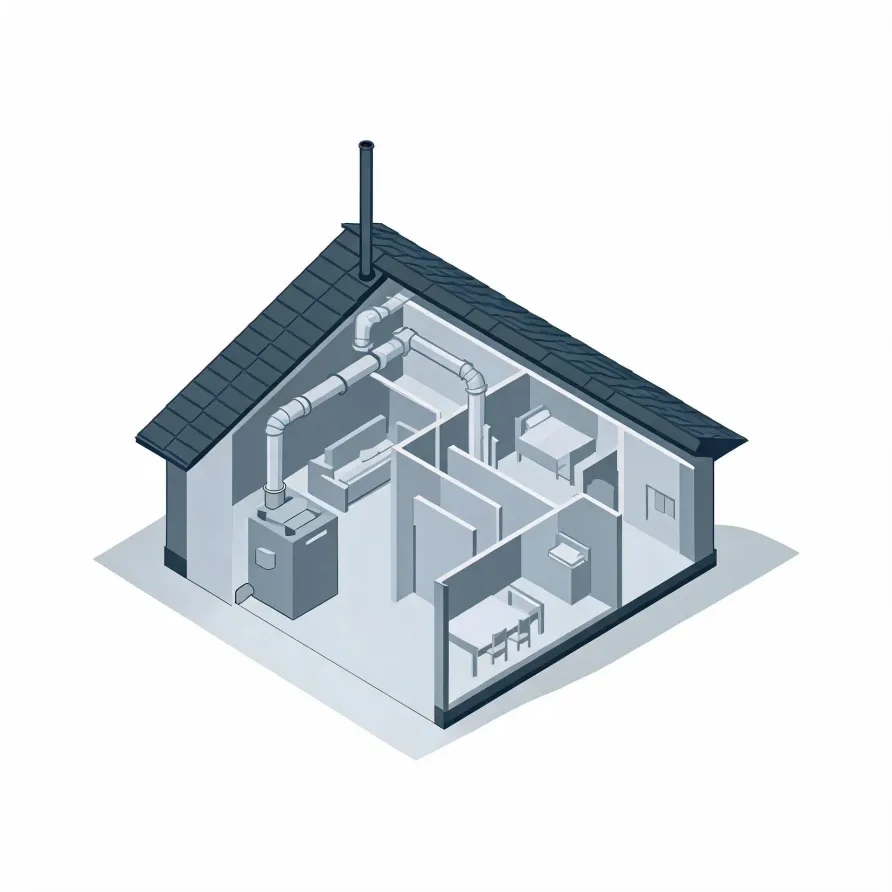
The furnace itself sits in a utility room, basement, or closet and is the piece a contractor goes to first. Inside it, the heat exchanger is the part that most often explains why a system is blowing cold air or shutting itself off early. The burners, which fire inside that exchanger, and the ignitor, which lights them, are two of the most common sources of a no-heat call.
The blower motor sits in the lower section of the furnace cabinet and pushes conditioned air out through the supply side of the house. Near it, the filter slot and the flame sensor are both small components that cause outsized problems when they are dirty or failing. The flue pipe runs from the top of the unit to the outside and is something a contractor checks whenever combustion or venting complaints come in.
The drawing shows the general layout of a furnace system, and a licensed contractor determines which components apply to your specific house and situation.
Find a contractor in Madison CountyMadison County, Tennessee, by the numbers
104 severe weather events were recorded in Madison County, Tennessee between 2015 and 2024.
NOAA National Centers for Environmental Information, Storm Events Database, bulk CSV export, events 2015-01-01 through 2024-12-31.Half the homes in Madison County, Tennessee were built in 1986 or earlier (2020-2024 ACS 5-year).
U.S. Census Bureau, 2020-2024 American Community Survey 5-Year EstimatesMadison County, Tennessee holds 44,091 housing units (2020-2024 ACS 5-year).
U.S. Census Bureau, 2020-2024 American Community Survey 5-Year EstimatesOwners occupy 62.0% of the occupied homes in Madison County, Tennessee (2020-2024 ACS 5-year).
U.S. Census Bureau, 2020-2024 American Community Survey 5-Year EstimatesRules & Standards for Furnace Repair in Madison County, Tennessee5 sourced rules and standards
What Happens When a Contractor Comes Out
Non-weatherized gas furnaces manufactured on or after November 19, 2015 must reach 80.0 percent AFUE.
Non-weatherized oil-fired furnaces manufactured on or after November 19, 2015 must reach 83.0 percent AFUE.
Mobile home gas furnaces manufactured on or after November 19, 2015 must reach 80.0 percent AFUE.
Non-weatherized gas furnaces manufactured on or after December 18, 2028 must reach 95.0 percent AFUE, up from the 80.0 percent minimum that applies to units manufactured before that date.
Licensing Rules for HVAC Repair in Madison County, Tennessee
Tennessee licenses contractors by classification, and HVAC, refrigeration and gas piping is one of them — a sub-classification of mechanical contracting on the licence the Board for Licensing Contractors issues.
Severe Weather Events in Madison County
Extreme weather puts furnaces under real stress, cycling them hard through cold snaps and power fluctuations that wear components faster than ordinary use. That wear is local, and the repair work that follows it is a local question.
104 severe weather events, 2015–2024. Source: NOAA National Centers for Environmental Information, Storm Events Database.