Tell us about the job
Takes about a minute. No obligation.
A contractor quoting furnace repair in Meigs County starts by ruling out the ordinary causes: a heat exchanger that has cycled past its limit, a control board that was never quite right from the day it went in, a filter schedule that slipped. 29 severe weather events were recorded in Meigs County, Tennessee between 2015 and 2024. At that rate, severe weather lands here as an event, not a steady grind on the equipment. The components that fail first in this county tend to fail because of age or because something in the original install left them working harder than they should have been.
Opened equipment in a house from this part of Meigs County's housing stock rarely tells a simple story. Half the homes in Meigs County, Tennessee were built in 1994 or earlier (2020-2024 ACS 5-year). A furnace running in stock that age has had time to accumulate prior repairs, substituted components, and at least one ownership change, and what a contractor finds inside the unit is shaped by all of that. The practical question on a repair call is whether the parts the current system requires are still in production, because a discontinued heat exchanger or a proprietary control board changes what the job costs and whether repair is the right path at all.
The Parts of a Furnace a Contractor Checks First
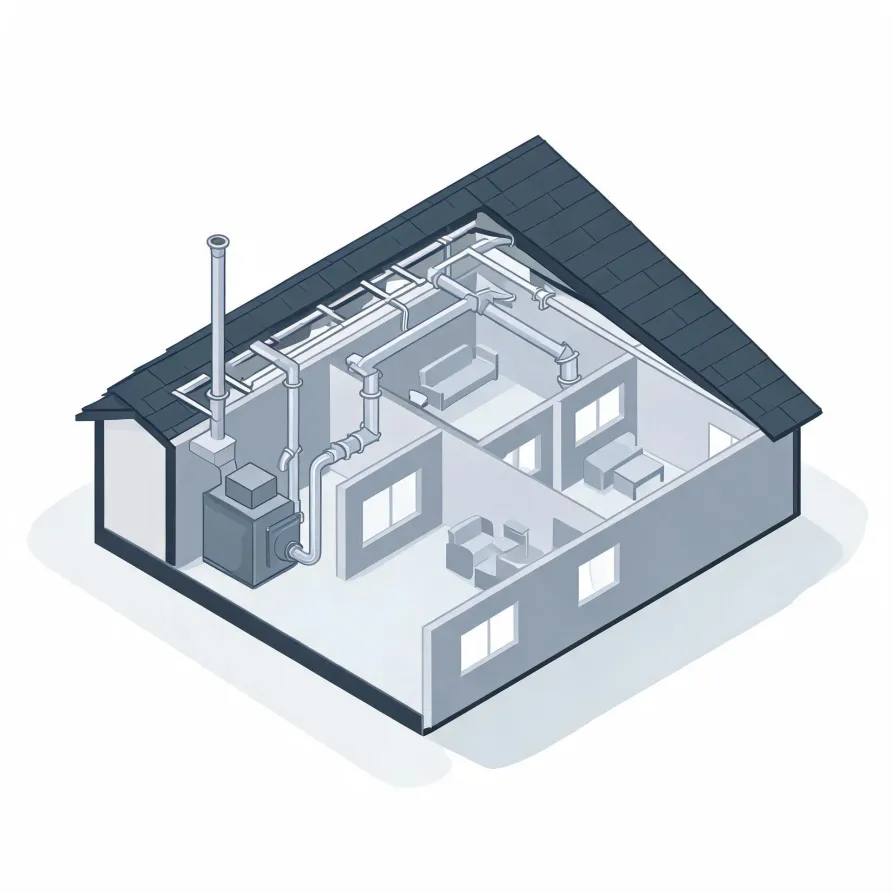
The furnace itself sits in a mechanical room, basement, or utility closet and is the piece a contractor goes to first. Inside it, the heat exchanger does the actual work of warming the air that moves through your home. A cracked or failing heat exchanger is one of the parts a contractor looks at closely, along with the burners that fire beneath it.
The blower motor and its fan sit inside the same cabinet, pushing conditioned air out through your supply system. Alongside those, the igniter, flame sensor, and control board each handle a specific part of the firing sequence, and a fault in any one of them can shut the furnace down or cause it to run poorly.
The drawing shows a typical furnace layout, and a licensed contractor determines which components apply to your specific system and situation.
Find a contractor in Meigs CountyMeigs County, by the numbers
29 severe weather events were recorded in Meigs County, Tennessee between 2015 and 2024.
NOAA National Centers for Environmental Information, Storm Events Database, bulk CSV export, events 2015-01-01 through 2024-12-31.Half the homes in Meigs County, Tennessee were built in 1994 or earlier (2020-2024 ACS 5-year).
U.S. Census Bureau, 2020-2024 American Community Survey 5-Year EstimatesMeigs County, Tennessee holds 6,275 housing units (2020-2024 ACS 5-year).
U.S. Census Bureau, 2020-2024 American Community Survey 5-Year EstimatesOwners occupy 81.0% of the occupied homes in Meigs County, Tennessee (2020-2024 ACS 5-year).
U.S. Census Bureau, 2020-2024 American Community Survey 5-Year EstimatesCodes & Standards Governing Furnace Repair in Meigs County, Tennessee5 sourced rules and standards
What furnace repair looks like in Meigs County
Non-weatherized gas furnaces manufactured on or after November 19, 2015 must reach 80.0 percent AFUE.
Non-weatherized oil-fired furnaces manufactured on or after November 19, 2015 must reach 83.0 percent AFUE.
Mobile home gas furnaces manufactured on or after November 19, 2015 must reach 80.0 percent AFUE.
Non-weatherized gas furnaces manufactured on or after December 18, 2028 must reach 95.0 percent AFUE, up from the 80.0 percent minimum that applies to units manufactured before that date.
Licensing and Legal Requirements in Meigs County, Tennessee
Tennessee licenses contractors by classification, and HVAC, refrigeration and gas piping is one of them — a sub-classification of mechanical contracting on the licence the Board for Licensing Contractors issues.
Severe Weather Events in Meigs County
Weather stress accumulates inside heating equipment whether or not a storm makes the news. How hard a furnace works, and how often it fails, is shaped by what the local climate puts it through year after year.
29 severe weather events, 2015–2024. Source: NOAA National Centers for Environmental Information, Storm Events Database.