
Tell us about the job
Takes about a minute. No obligation.
Furnace repair in Lawrence County starts with what the system has already been through, and that question has a real answer. 209 severe weather events were recorded in Lawrence County, Tennessee between 2015 and 2024. At that rate, severe weather is a recurring condition for equipment here, and a contractor diagnosing a failed heat exchanger or a worn ignition assembly is looking at accumulated stress, not a one-off bad season. A homeowner expecting a simple fix can find the scope wider than quoted once a contractor opens the unit and sees what steady weather load does to components over time.
Older furnaces accumulate a specific problem: the components they take get discontinued, and a unit that still runs can become unserviceable the moment a heat exchanger or inducer motor fails and the part number no longer exists. Half the homes in Lawrence County, Tennessee were built in 1983 or earlier (2020-2024 ACS 5-year). That concentration of older housing means a contractor opening a furnace here finds equipment whose replacement parts may sit at the edge of availability, and sometimes past it. When that is the case, a repair quote and a replacement conversation happen in the same visit.
The Parts of a Furnace a Contractor Checks First
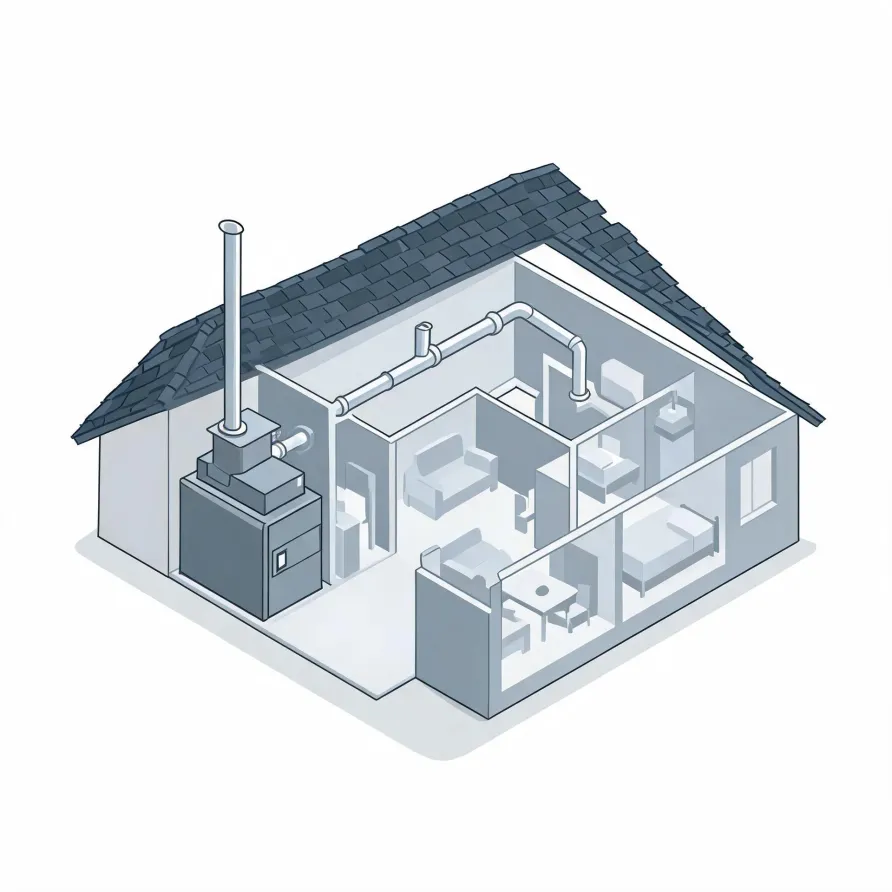
The heat exchanger sits at the core of the furnace cabinet and is the piece a contractor looks at closely when a furnace runs but does not heat properly or produces unusual odors. The burner assembly sits just below it and is where the flame originates. A fault in either one accounts for a large share of furnace calls.
The blower motor and its fan wheel sit in the lower half of the cabinet and push conditioned air into the duct system. The inducer motor pulls combustion gases out through the flue. The control board and the igniter are smaller components, but either one going wrong can shut the whole system down as surely as anything else in the cabinet.
The drawing shows the general layout of a furnace system, and a licensed contractor determines what applies to the specific unit and installation in your home.
Find a contractor in Lawrence CountyLawrence County, by the numbers
209 severe weather events were recorded in Lawrence County, Tennessee between 2015 and 2024.
NOAA National Centers for Environmental Information, Storm Events Database, bulk CSV export, events 2015-01-01 through 2024-12-31.Half the homes in Lawrence County, Tennessee were built in 1983 or earlier (2020-2024 ACS 5-year).
U.S. Census Bureau, 2020-2024 American Community Survey 5-Year EstimatesLawrence County, Tennessee holds 18,730 housing units (2020-2024 ACS 5-year).
U.S. Census Bureau, 2020-2024 American Community Survey 5-Year EstimatesOwners occupy 77.6% of the occupied homes in Lawrence County, Tennessee (2020-2024 ACS 5-year).
U.S. Census Bureau, 2020-2024 American Community Survey 5-Year EstimatesCodes & Standards Governing Furnace Repair in Lawrence County, Tennessee5 sourced rules and standards
What Furnace Repair Looks Like in Lawrence County
Non-weatherized gas furnaces manufactured on or after November 19, 2015 must reach 80.0 percent AFUE.
Non-weatherized oil-fired furnaces manufactured on or after November 19, 2015 must reach 83.0 percent AFUE.
Mobile home gas furnaces manufactured on or after November 19, 2015 must reach 80.0 percent AFUE.
Non-weatherized gas furnaces manufactured on or after December 18, 2028 must reach 95.0 percent AFUE, up from the 80.0 percent minimum that applies to units manufactured before that date.
Licensing Rules for HVAC Work in Lawrence County, Tennessee
Tennessee licenses contractors by classification, and HVAC, refrigeration and gas piping is one of them — a sub-classification of mechanical contracting on the licence the Board for Licensing Contractors issues.
Severe Weather Events in Lawrence County
Extreme weather puts real strain on furnace components, from pressure switches and heat exchangers to ignitors and blower motors. How hard that equipment works over its lifetime is a local question, and the record below reflects what Lawrence County weather has asked of it.
209 severe weather events, 2015–2024. Source: NOAA National Centers for Environmental Information, Storm Events Database.