Tell us about the job
Takes about a minute. No obligation.
Furnace repairs in this county carry a specific diagnostic weight because the equipment has been running against real, repeated environmental load. 136 severe weather events were recorded in Putnam County, Tennessee between 2015 and 2024. A contractor working a furnace here checks the heat exchanger and ignition components early, because those are the parts that absorb the strain of a system cycling hard and often through difficult seasons. Age matters too, but in this county the weather history is the first thing a contractor has to account for before settling on a cause.
Furnaces in housing this old have had time to cycle through more than one replacement, which means what a contractor pulls out of an opened unit may be a model whose heat exchanger, draft inducer, or control board manufacturers stopped making years ago. Half the homes in Putnam County, Tennessee were built in 1991 or earlier (2020-2024 ACS 5-year). When a part is discontinued, the repair scope changes: a contractor has to source from specialty suppliers or remanufacturers, and the cost and timeline shift accordingly. That is what the age of this stock actually determines on a repair call.
The Parts of a Furnace a Contractor Checks First
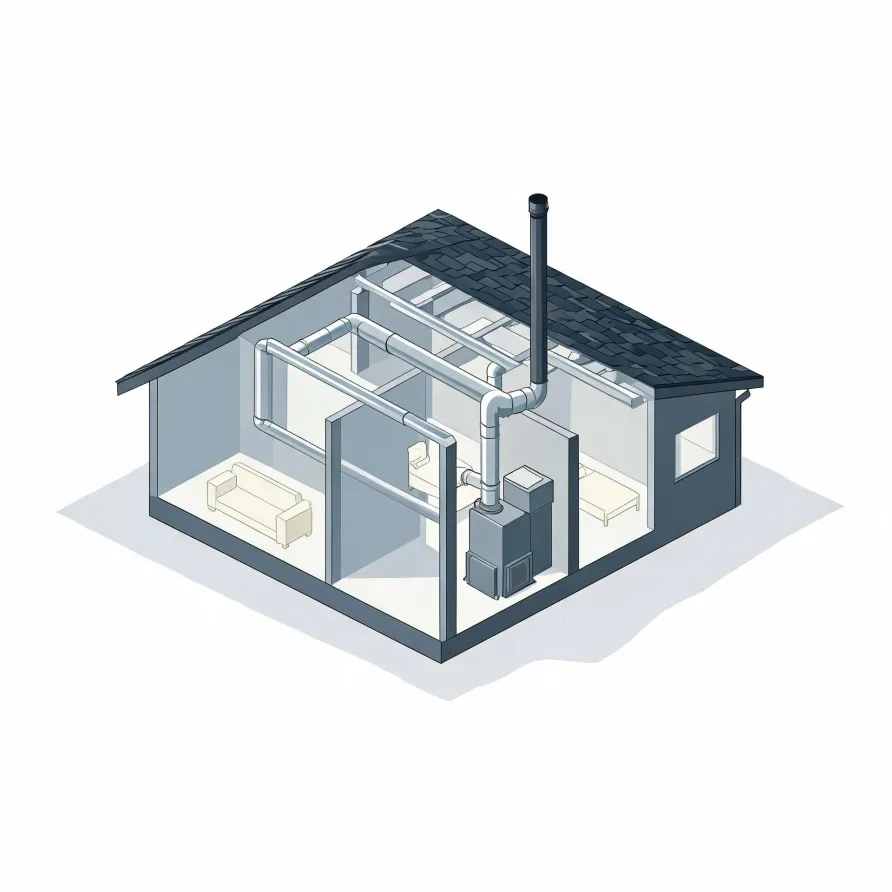
The furnace itself sits in a mechanical room, basement, or closet and is the core of the system. Inside it, the heat exchanger is the piece a contractor looks at closely during a repair call. Cracks or failures there affect both performance and safety, which makes it a common starting point.
The blower motor and its fan sit inside the furnace cabinet and push conditioned air out through the supply side of the house. The burner assembly and igniter sit at the base of the heat exchanger. When a furnace stops heating or cycles erratically, those two components are where a contractor typically turns next, along with the flue that vents combustion gases out of the home.
The drawing shows a general layout of the system, and a licensed contractor determines which components apply to your specific house and situation.
Find a contractor in Putnam CountyPutnam County, by the numbers
136 severe weather events were recorded in Putnam County, Tennessee between 2015 and 2024.
NOAA National Centers for Environmental Information, Storm Events Database, bulk CSV export, events 2015-01-01 through 2024-12-31.Half the homes in Putnam County, Tennessee were built in 1991 or earlier (2020-2024 ACS 5-year).
U.S. Census Bureau, 2020-2024 American Community Survey 5-Year EstimatesPutnam County, Tennessee holds 36,506 housing units (2020-2024 ACS 5-year).
U.S. Census Bureau, 2020-2024 American Community Survey 5-Year EstimatesOwners occupy 61.2% of the occupied homes in Putnam County, Tennessee (2020-2024 ACS 5-year).
U.S. Census Bureau, 2020-2024 American Community Survey 5-Year EstimatesCodes & Standards Covering Furnace Repair in Putnam County, Tennessee5 sourced rules & standards
What Happens When a Contractor Comes Out
Non-weatherized gas furnaces manufactured on or after November 19, 2015 must reach 80.0 percent AFUE.
Non-weatherized oil-fired furnaces manufactured on or after November 19, 2015 must reach 83.0 percent AFUE.
Mobile home gas furnaces manufactured on or after November 19, 2015 must reach 80.0 percent AFUE.
Non-weatherized gas furnaces manufactured on or after December 18, 2028 must reach 95.0 percent AFUE, up from the 80.0 percent minimum that applies to units manufactured before that date.
Licensing and Legal Requirements in Putnam County, Tennessee
Tennessee licenses contractors by classification, and HVAC, refrigeration and gas piping is one of them — a sub-classification of mechanical contracting on the licence the Board for Licensing Contractors issues.
Severe Weather Events in Putnam County
Hard weather puts stress on heating equipment that adds up over time. How much stress depends on where the equipment sits, which makes Putnam County conditions a practical factor in how often furnaces here need repair.
136 severe weather events, 2015–2024. Source: NOAA National Centers for Environmental Information, Storm Events Database.