Tell us about the job
Takes about a minute. No obligation.
A furnace repair in Fentress County starts with the system itself, not the season. 74 severe weather events were recorded in Fentress County, Tennessee between 2015 and 2024. At that rate, severe weather is a real but irregular part of life for equipment here, not the constant grind that wears a heat exchanger or a blower motor down on its own. A contractor working a furnace call in this area will check filter history, venting condition, and component age because those are what usually account for what failed. The weather is context, not cause.
Furnace repair in a house with serious age behind it tends to open up differently than the service call suggests at the door. Half the homes in Fentress County, Tennessee were built in 1987 or earlier (2020-2024 ACS 5-year). Equipment installed into stock like this has been running long enough that heat exchangers crack in ways that are specific to how these systems were originally set up, and the parts a contractor needs to order are sometimes no longer in production. A discontinued part changes what a repair costs and whether it is worth completing at all, which a contractor has to answer once the unit is open, not before.
The Parts of a Furnace a Contractor Checks First
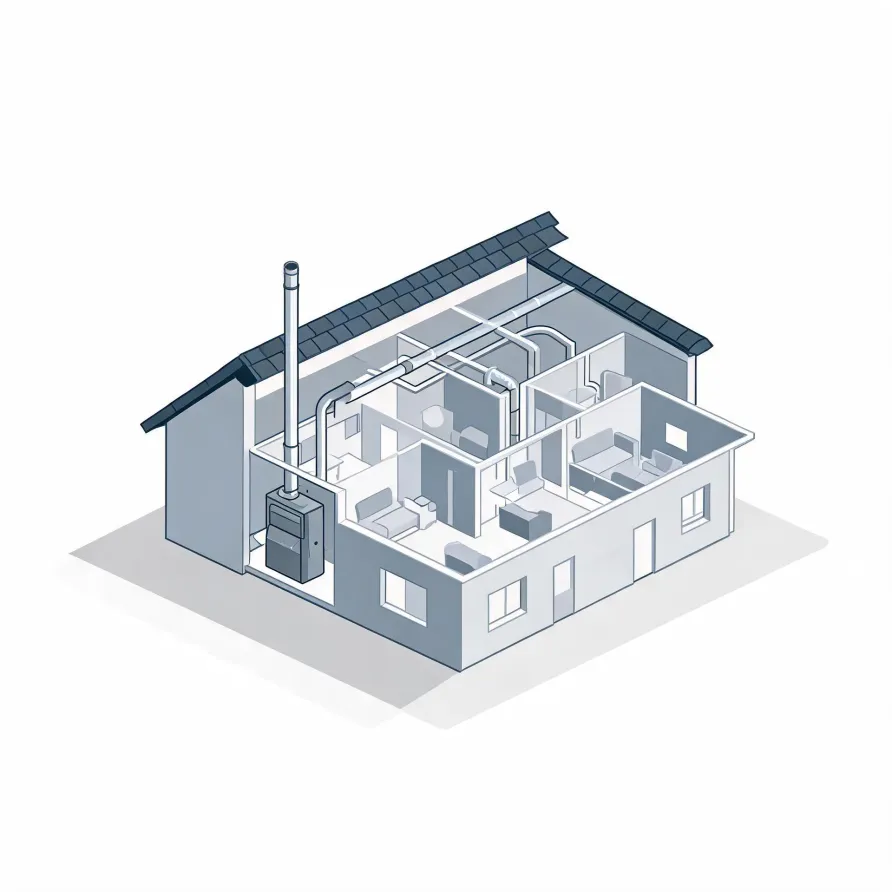
The heat exchanger sits at the core of the furnace cabinet, in the basement or utility room, and it is where combustion heat transfers to the air moving through your home. Cracks or stress in this component are a common source of both heating failure and carbon monoxide risk. The burner assembly feeds directly into it, and a contractor looks at both together when heat output is weak or absent.
The blower motor and its fan wheel sit below the heat exchanger and push conditioned air into the supply ducts. A failed or struggling motor is often what turns a functioning furnace into one that runs but moves no air. The flue and draft inducer pull combustion gases out through the venting that exits the cabinet, and blockages or inducer failure show up as ignition lockouts or repeated short cycling.
The drawing shows a general furnace layout, and a licensed contractor determines which components apply to your specific installation.
Find a contractor in Fentress CountyFentress County, by the numbers
74 severe weather events were recorded in Fentress County, Tennessee between 2015 and 2024.
NOAA National Centers for Environmental Information, Storm Events Database, bulk CSV export, events 2015-01-01 through 2024-12-31.Half the homes in Fentress County, Tennessee were built in 1987 or earlier (2020-2024 ACS 5-year).
U.S. Census Bureau, 2020-2024 American Community Survey 5-Year EstimatesFentress County, Tennessee holds 9,260 housing units (2020-2024 ACS 5-year).
U.S. Census Bureau, 2020-2024 American Community Survey 5-Year EstimatesOwners occupy 82.6% of the occupied homes in Fentress County, Tennessee (2020-2024 ACS 5-year).
U.S. Census Bureau, 2020-2024 American Community Survey 5-Year EstimatesCodes & Standards Covering Furnace Repair in Fentress County, Tennessee5 sourced rules & standards
What Happens When the Contractor Comes Out
Non-weatherized gas furnaces manufactured on or after November 19, 2015 must reach 80.0 percent AFUE.
Non-weatherized oil-fired furnaces manufactured on or after November 19, 2015 must reach 83.0 percent AFUE.
Mobile home gas furnaces manufactured on or after November 19, 2015 must reach 80.0 percent AFUE.
Non-weatherized gas furnaces manufactured on or after December 18, 2028 must reach 95.0 percent AFUE, up from the 80.0 percent minimum that applies to units manufactured before that date.
Licensing Rules for Fentress County, Tennessee
Tennessee licenses contractors by classification, and HVAC, refrigeration and gas piping is one of them — a sub-classification of mechanical contracting on the licence the Board for Licensing Contractors issues.
Severe Weather Events in Fentress County
Hard weather puts real hours on a furnace. Every heating system in Fentress County carries that load, and a contractor working here accounts for it.
74 severe weather events, 2015–2024. Source: NOAA National Centers for Environmental Information, Storm Events Database.